

Have you been missing the hands-on experimentation in biology class, which makes concepts feel abstract and limits skill development? Do processes like cellular respiration, genetics, and molecular biology seem too challenging through static text or low-quality videos? Then, this step-by-step guide to studying biology effectively is your answer!
Table of Contents
ToggleFrom limited instructor interaction to delayed feedback, tackling online biology can feel like a war! Interestingly, we recently conducted a survey that showed that around 7 out of 10 students in the biology class drop out each year because they cannot cope with the challenges.
This blog includes tried-and-tested methods, strategies, game-changing study tips for biology classes, and the best ways to study biology online, ensuring no student drops out but instead achieves success!
Key Takeaways: 5 Most Essential Study Tips for Biology Classes
- Study biology regularly instead of relying on last-minute cramming.
- Draw diagrams, create mind maps, use flashcards, and explain concepts in your own words.
- Use practice questions and past papers, then review your mistakes to identify weak areas.
- Break complex topics into smaller parts and focus on foundational concepts such as cell biology, genetics, and evolution.
- Review material at increasing intervals and reinforce difficult concepts with diagrams, stories, and analogies.
How to Study for Biology: Use Effective Study Techniques That Work
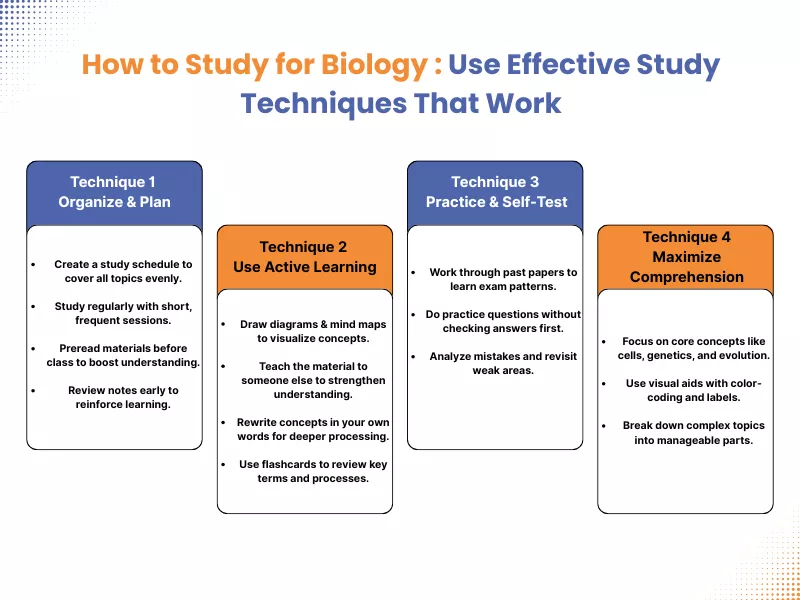
Let’s start with the study strategies and techniques that you can use to maximize your time and understanding before you request take my online class for me:
Technique #1: Organize and Plan Your Study Time
Here are 4 online biology class success strategies:
Create a schedule: Set aside dedicated time for each topic to ensure balanced coverage and avoid last-minute cramming.
Study regularly: Make learning a daily or weekly routine. Shorter, frequent study sessions over time are more effective than long, infrequent ones.
Preread material: Before a lecture, read the assigned text to familiarize yourself with the concepts and take notes.
Review notes: Go over your lecture and textbook notes soon after class to reinforce the material; it works better than aimless memorization.
Technique #2: Use Active Learning Techniques
Draw diagrams and mind maps: Biology is visual. Sketching cell structures, cycles, or food webs helps you visualize and understand relationships.
Fun Fact: One of the best and easiest ways to make a mind map is to use NoteBookLM. It is free and safe. Just upload all your notes, videos, or e-textbooks, and get a mind map ready in just 2 mins!
Teach the material: Explaining concepts to a friend, family member, or even a study group solidifies your knowledge and exposes gaps in your understanding. You can also tutor your siblings!
Write in your own words: Don’t just reread and memorize your notes; rewrite concepts in your own words to process and store the information more effectively.
Use flashcards: Create flashcards for key terms, processes, and diagrams, and quiz yourself frequently.
Furthermore, for Capella University course help, you can join an internal study group or hire an expert when taking a biology class.
Technique #3: Practice and Test Yourself
Work through past papers: This is one of the most effective ways to prepare. It helps you understand the exam format and identify frequently tested topics.
Do practice questions: One of the best biology exam preparation tips is actively answering practice questions from lectures, study guides, or the textbook without looking at the answers.
Analyze mistakes: When you get a question wrong, review the answer to understand your misconception, and practice more on that specific topic.
Trivia: You can always hire someone to take my online Biology class, if things go south!
Technique #4: Maximize comprehension
Focus on core concepts:
Prioritize understanding foundational topics like cell biology, genetics, and evolution, as they are central to your coursework. When mastering these heavy topics proves difficult, online biology class help offers targeted guidance.
10 Top Study Tips for Biology Classes: Turn Your Biology Boogie into Biggie!

Dance with the Diagrams
Biology loves visuals. So, the first study tip for online biology students is to redraw processes, label parts, and color-code everything. If it looks like a kid’s science book, you’re doing it right.
Talk to Your Stuffed Animals (or Pets… or Plants)
Don’t confine yourself or your biology studies to textbooks alone. Explain concepts covered in specialized human biology classes online out loud to something that can’t judge you. Teaching is science sorcery—it forces your brain to organize info.
Build Mnemonics That Are So Weird You Can’t Forget Them
Your understanding of biology should not be limited to study schedules or office hours when you get to talk to your instructor! Building mnemonics is one of the most effective biology study hacks because it increases your familiarity with the material.
The weirder, the stickier.
Example: KPCOFGS → “Kangaroos Prefer Cell Organelles For Good Science.” Or better yet, make your own.
Turn Biology Processes Into Mini Stories
Pretend your cells are quirky characters living dramatic lives. It’s one of those strategies that worked for 7 out of 10 students in our research! “ATP is the exhausted parent paying everyone’s energy bills.”
Spaced Repetition = Brain Gains
To enhance your understanding and retention, don’t just rewrite your notes; review old material at increasing intervals. It’s like making your memory do push-ups.
Watch Biology Videos at 1.25x Speed
Just fast enough to keep your brain awake, not fast enough to cause existential dread. Online classes assistance vs. self-learning not only offer an interactive learning experience but also lead to procrastination and boredom. Speed wakes up your mind and boosts your learning.
Use Real-Life Examples
Biology learning is all about connecting dots. Relate everything to your body, your pet, or that weird fungus growing in your fridge. Suddenly, everything clicks.
Build a “Bio Binder of Doom.”
Organize notes into neat sections:
🧬 Genetics
🌱 Plants
🧫 Microbiology
🐸 Ecology
Your future self will thank you at exam time.
Turn Big Topics into Mind Maps
Start with a central idea and significant areas of biology (e.g., Photosynthesis) and branch out. Make it colorful. Make it messy. Make it yours.
Sleep Like It’s Part of the Syllabus
Because it is, memory consolidates during sleep. When you regularly test your knowledge, you must know about REM Sleep. If not, then you need sleep! All-nighters = biological sabotage.
Now, let’s check out 4 effective study methods for biology exams to succeed in your online classes!
4 Study Methods to Crack Biology Exams

Storytelling Your Biology
- Turn processes into mini-stories or “soap operas.”
- Example: Imagine a glucose molecule’s journey through cellular respiration as an adventurous hero.
- Makes abstract concepts easier to remember.
Conceptual Linking
- Connect unrelated topics to form a web of understanding.
- Example: Link photosynthesis → oxygen release → human respiration → ecology.
- Helps in answering application-based questions.
Use Analogies and Comparisons
Compare complex processes to everyday things:
- DNA replication → a copy machine
- Enzyme-substrate interaction → lock and key
Makes tricky concepts intuitive.
Whiteboard Brainstorming
- Before your next biology test, draw diagrams, cycles, and tables of complex biology concepts on a whiteboard instead of paper.
- Erasing and rewriting reinforces memory.
- Great for visual and kinesthetic learners.
Conclusion
Studying Biology requires not only online resources and a study room but also effective learning strategies that boost your retention and help you understand the material better. From practicing key concepts to getting feedback from instructors and friends, we feel this comprehensive guide has already made the journey smoother; all you need to do is study smartly. So, revisit your notes and the textbook lying on your bed and fill in any gaps you had earlier!
Frequently Asked Questions
How to Study for Biology in College?
Biology is a vast subject! Whether you’re studying for AP Bio, preparing for an upcoming weekly quiz, or facing finals, your learning approach can make all the difference. Therefore, solidify your understanding with an active recall session. When tackling a complex biological concept, break it down into smaller, digestible parts. Use college resources and make the most of biology study sessions with your friends. Identify areas you need to work on, and if needed, get help from Khan Academy.
How to Improve Biology Grades Online?
You can improve your grades in an online biology class by participating in discussion boards, actively studying, and taking weekly quizzes diligently.
How to Organize Notes for Your Biology Class?
Use a structured system—either digital (OneNote, Notion, Google Docs) or paper (binder with dividers). Organize by units, chapters, and subtopics, and highlight key definitions, diagrams, and formulas.
How to Stay Focused in an Online Biology Course?
Use the Pomodoro technique: 25 minutes of focused study, 5-minute break, repeat. Longer sessions can lead to fatigue; this technique will help you retain information longer!