
Are you confused about how to ask questions in online classes? We understand. Many students do not feel comfortable asking questions during classes, even if it is an online session. However, question-asking is essential to seek clarification.
Table of Contents
ToggleIf the doubt remains, you will struggle to have a deeper understanding of a specific concept. Hence, in this article, we have shared some valuable tips for you to actively spark discussion and engage with your teacher by asking doubt clarifying questions. Let’s begin!
Key Takeaways
- Always prepare and review materials before asking questions to make them clear and focused.
- Choose the right platform (forums, email, or live sessions) based on your question type.
- Keep your tone respectful, patient, and professional when communicating online.
- Ask questions that promote critical thinking, not just yes/no answers.
- Regular participation and curiosity strengthen understanding and engagement in virtual classes.
What Is the Importance of Effective Questioning in Virtual Classes?
In a physical setting, a student can raise their hand and ask for clarification. But when it comes to online classes, a communication gap happens. Watching lecture videos or simply reading the syllabus is not enough. You may require additional explanation for certain course materials.
Plus, a teacher wouldn’t know if you are having a hard time understanding a topic or concept unless you tell them. Therefore, silence is never an option. Proper interaction is key to having a successful online learning journey.
Moreover, seeking answers by asking questions shows that you are curious to explore more. Engaging in online class discussions not only clears confusion but also instills confidence. You will receive extended guidance beyond the textbook, which will enhance your learning experience.
Also, when you analyze complex topics and request logical clarification. You help classmates view material from new angles.
How to Ask Questions in Online Classes?
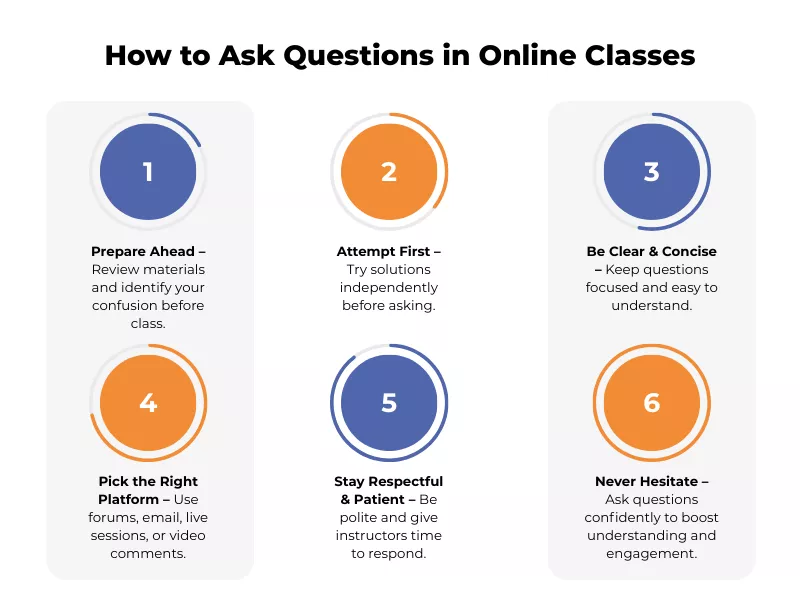
Read to break the silence? Here are some effective tips for asking questions in virtual learning:
1. Prepare Ahead
Before you even type your query, make all the preparations. One effective strategy involves preparing questions before the online class session starts. This is a proactive system, which avoids scrambling in real-time lectures.
First of all, review syllabi or pre-reading materials, as they may reveal confusion early. Also, revisit lectures, readings, and relevant resources. You may find your question has already answered there.
Next, try to identify the exact problem you currently struggle with. It is essential to decide whether confusion involves concepts, assignment steps, or scope.
Additionally, try to attempt solutions independently before requesting direct assistance right away. Explore approaches, research sources, and textbooks to deepen understanding.
This preparation helps clarity and shows your effort to the instructor.
2. Make Sure Your Question is Clear and Concise
Clarity is important when you are prepared to question things. Failure to be precise and clear is one of the most common mistakes in online classes made by students. A well-crafted question assists the instructors in interpreting needs. Here’s how to do it:
- Speak plainly and never use ambiguous words.
- Write down what you are confused about the topic.
- Give background information regarding the course, module, or assignment.
- Break down complex questions into brief and focused questions.
- Proofread carefully to ensure clarity and readability always.
3. Choose Your Platform
There are several communication avenues in online courses. Choose any of them. For example, these are the best ways to ask questions online:
- General questions and discussion are best done in discussion forums. They promote idea exchange and interactions on the internet.
- Email to address personal problems or grade issues directly. Use it for extensions or private matters only.
- Live question and answer sessions enable one to communicate with instructors in real-time. You are able to pose questions and get instant feedback.
- A video comment helps in responding to certain lecture points. These remarks relate questions to specific moments depicted.
4. Keep The Tone Respectful & Be Patient
Keep in mind that teachers have to deal with numerous students simultaneously. They will not be able to react to all messages instantly. Speak in a friendly and professional manner.
Treat your instructor with respect and do not use demanding language. Be patient and wait to be responded to. Give time to follow-up messages.
Do not send too many reminders at the same time. When you get a response, respond in a polite way. Show that you are grateful for their time and guidance.
5. Do a Quick Platform Search
Search on the platform before posing a question. Most app courses like Udemy feature searchable discussion boards or frequently asked questions. That question may have been answered already in those resources.
6. Never Be Afraid to Ask Your Instructor!
At times, students lose out on an opportunity when they are afraid to ask questions. Students fear that they will look unprepared or dumb. Remember, everyone participates to learn and improve understanding.
Fear should not prevent you from finding invaluable clarification or professional assistance to take my online class. Questions help you succeed and empower you to build academic confidence.
How to Phrase Questions Effectively in Online Classes?
Learning to ask questions is the key to active learning. It changes passive listening to active listening. Want to maximize learning? Then, one technique is to frame questions beyond simple answers. Never ask yes or no only. It is your ambition as a learner to challenge deep thinking.
You should generate inquiries that encourage thoughtful discussion. Another thing that is important is the format of your question. Be brief and straight in discussions. Understandable language assists the instructors in providing accurate responses.
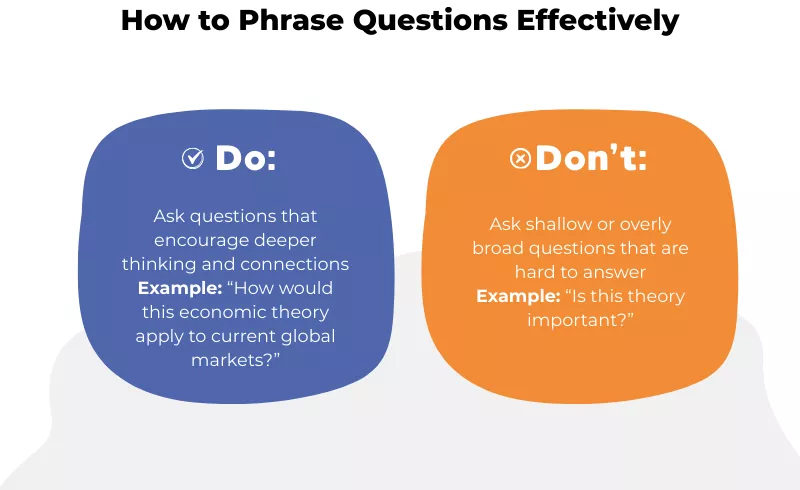
Here are some subject-specific samples showing how to phrase questions in online class:
Maths
- “Can you explain the logic behind this derivation step?”
- “How would this equation change in 3D instead of 2D?”
Science
- “Which environmental factors could affect the experiment’s results?”
- “How does this organism’s cellular structure compare to last week’s?”
History
- “How did the economic climate influence this leader’s decisions?”
- “How does this primary source differ from the textbook narrative?”
Literature
- “How do recurring motifs in chapter one foreshadow the protagonist’s downfall?”
- “How does analyzing this poem through feminism or post-colonialism change its theme?”
Tips to Improve Questioning Skills Virtual Classroom
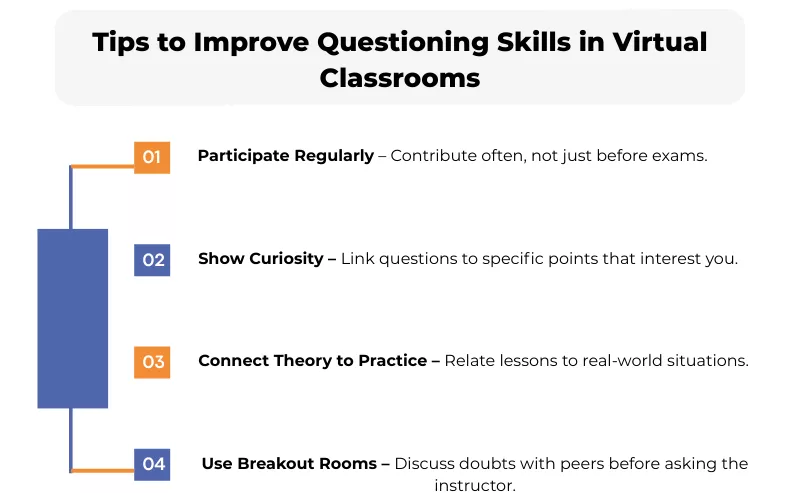
What to refine your choice questions and ability to communicate with instructors further? Then, consider these strategies to make your inquiries more impactful:
- Establish a Habit of Participation: Don’t wait until the week before an exam to speak up. Try to contribute regularly, even once per session. This helps to build rapport with your instructor and stay consistently engaged.
- Show Your Curiosity: When you ask something, try to link it to a specific point that sparked your interest. This shows the instructor that you are actively listening.
- Connect Theory to Practice: To deepen your understanding, try to formulate questions that apply the lesson to a real-world situation. For example: “How would this economic theory apply to the current global market?”
- Utilize Breakout Rooms: If your class uses small group sessions, use that time to introduce a specific doubt to your peers first. Often, discussing a problem peer-to-peer helps you refine your question before presenting it to the professor.
Final Thoughts
Developing strong inquiry skills helps every learner grow. It lets you access your instructor’s deep expertise easily. This approach bridges gaps created by digital distance. Virtual classrooms can sometimes feel distant or impersonal. Asking questions encourages stronger engagement with learning materials. It also supports a more personalized learning experience overall. By moving beyond passive observation, you gain control. You guide your academic journey with confidence. This ensures nothing slows your learning progress. So, don’t hesitate ever!
Frequently Asked Questions (FAQs)
What is the best way to ask questions in online classes without interrupting?
Click on the icon of raising hands or wait till the instructor pauses between slides. This is the most effective way of asking questions during online class without interrupting.
Can I ask questions in online classes after the session ends?
Yes! You can ask questions in online classes after the session ends.
How to ask questions during a group discussion?
During group discussions, always wait until a peer finishes speaking first. Then, ask questions using the chat. Use phrases that build on others’ ideas. Ask how their point connects to the topic. This method helps you engage without disrupting the discussion. It also shows respect for classmates’ shared input.
What should I do if my question doesn’t get answered during the live session?
If class ends before your question gets addressed, act quickly. Do not allow confusion to linger after class. Post your question on the discussion board. You may also send a polite follow-up email.